Loading Events

Long-Acting Injectable (LAI) Generics: Navigating Technical Hurdles in Product Development and Regulatory Assessment

Date and Time: December 1 , 8:00 am  –  5:45 pm ,
December 2 , 8:00 am  –  4:00 pm

Co-hosts: FDA and the Center for Research on Complex Generics (CRCG)

In person (at The Universities at Shady Grove; Rockville, MD) and virtual workshop.

Registration Now Open

The development and regulatory assessment of long-acting injectable (LAI) generic products present some of the most technically demanding challenges in the generic drug space. From complex excipient characterization and reverse engineering to in vitro release testing (IVRT) and pharmacokinetic (PK) study design, LAI generics require a sophisticated, multi-disciplinary approach that spans formulation science, analytical chemistry, modeling, and regulatory strategy. The purpose of this two-day workshop is to facilitate an in-depth examination of current challenges and emerging solutions relating to LAI product development and regulatory assessment.

Attendees will gain valuable insights into the intricacies of developing generic LAI products across a range of dosage forms, including drug substance suspensions, polymeric microspheres, implants, in situ forming depots, etc. The 2-day workshop will explore the connections between drug release mechanisms, relevant in vitro methodologies, and predictive modeling approaches, with a focus on defining their current utility in specific regulatory contexts. Sessions will discuss common deficiencies identified during ANDA assessment of LAI products, alternative bioequivalence study designs, and model-integrated evidence approaches that enable more efficient and feasible bioequivalence assessment.

In addition to expert-led presentations and panel discussions, in-person attendees will have the opportunity to engage directly with experts from industry, academia and regulatory agencies through the open exchange and small group working sessions. These sessions are designed to deepen participants’ understanding of current practices and challenges, regulatory expectations, and emerging trends in the field.

Choose your experience:

VIRTUAL ATTENDANCE:

All attendees will enjoy a series of expert-led presentations and panel discussions that provide valuable insights into critical aspects of LAI product development including formulation, excipient characterization, and manufacturing considerations; drug release mechanisms and the role of IVRT studies to support a demonstration of bioequivalence; novel in vivo pharmacokinetics study designs; and the use of model-integrated evidence. Virtual attendees will be able to:

  • Attend all presentations and panel discussions
  • Participate in all Q&A panel discussions by submitting questions online in real time to the speakers and panelists
  • Enjoy free access to workshop recordings of presentations and panel discussions (not including the in-person-only sessions)

IN-PERSON ATTENDANCE:

In-person attendees will enjoy all the benefits of virtual attendance and, additionally, interact directly with experts from FDA, academia, industry, consulting groups, and others to deepen their understanding of current practices and challenges, regulatory expectations, and emerging trends. These high-engagement scientific interactions will be facilitated through two in-person-only sessions:

  • A session dedicated to interactive discussions and candid dialogue with FDA, Industry, Academic, and other subject matter experts about scientific and regulatory challenges for complex LAI products.
  • A guided session for small groups of in-person attendees including real-world case studies and consensus mapping to identify priorities and actionable outcomes by working through challenging issues for LAI formulation and excipient characterization, IVRT method development, alternative BE approaches, and model-integrated evidence strategies.

Workshop Topics

  • Formulation, excipient characterization and manufacturing considerations
  • Mechanistic understanding of drug release mechanisms and in vitro drug release testing
  • Alternative bioequivalence approaches and alternative pharmacokinetics study design
  • Model-integrated evidence approaches

Audience

This workshop is designed for professionals involved in the development, manufacturing, and regulation of generic products. The target audience includes pharmaceutical scientists (formulation and product development scientists, analytical chemists, quality assurance and control experts), regulatory affairs professionals, clinical development professionals, and manufacturing experts. Additionally, the workshop will be valuable for academic researchers in pharmaceutical sciences, representatives from contract research organizations (CROs) and contract manufacturing organizations (CMOs), regulatory agency staff, and healthcare professionals interested in generic complex drug products. The content is tailored to accommodate participants with varying levels of expertise in LAI products, from those seeking to understand the fundamentals to advanced practitioners looking to stay abreast of the latest regulatory considerations and development strategies.

  • Virtual Attendance is ideal for those who wish to access expert presentations and panel discussions remotely, eliminate travel requirements, and have the flexibility to engage with content in real time or on demand.
  • In-Person Attendance is best for participants seeking high-level engagement through collaborative small group working sessions, direct interaction with experts from industry, academia and FDA, and immersive learning focused on real-world challenges and problem-solving.

Registration Fees:

  • This workshop is FREE for virtual attendees.
  • The combined cost for the two-day workshop in-person attendance and activities is:
    • $350, in-person attendees – general
    • $150, in-person attendees – government (must have an email ending in “.gov” to register at this rate)

For faculty and students from the University of Maryland, Baltimore, The Universities at Shady Grove, and University of Michigan, please contact CRCG (info@complexgenerics.org) regarding registration.

Continuing education (CE) credits will not be provided for attending this workshop.  A certificate of attendance will only be provided to individuals attending in-person, when requested.

For in-person attendees, beverages and food for breaks will be provided; Lunch will not be provided. Please visit the CRCG website regarding pre-ordering lunch instructions. Links will be provided once they are available. Orders must be placed by November 16 (5 PM ET). Also there is an onsite cafe for purchasing food or you are welcome to bring your own lunch.

Introduction to the Workshop

This two-day workshop will address the most pressing scientific and regulatory challenges in the development and assessment of long-acting injectable (LAI) generic products. The program will explore the technical hurdles associated with LAI formulation development, including complex excipient characterization, reverse engineering, and manufacturing considerations that influence product performance and batch consistency. Sessions will cover drug release mechanisms across diverse LAI platforms and the development of discriminatory in vitro release testing (IVRT) methods.

The workshop will also address alternative bioequivalence strategies and innovative pharmacokinetic (PK) study designs that reduce the burden of traditional BE studies while maintaining scientific rigor. Model-integrated evidence (MIE) approaches, including population PK modeling and mechanistic physiologically-based pharmacokinetic (PBPK) modeling, will be discussed as tools to accelerate generic LAI development and support regulatory submissions. Common deficiencies identified during ANDA assessment for LAI products will be highlighted, with an emphasis on best practices and actionable solutions.

Sessions will feature expert presentations, case studies, and interactive panel discussions. In-person attendees will have an additional opportunity to participate in the open exchange and small-group working sessions focused on real-world challenges, best practices, and actionable solutions, offering direct engagement with regulators and thought leaders from industry and academia.

DAY 1

Session 1: Critical Aspects of LAI Development: Formulation, Excipient Characterization, and Manufacturing Considerations

Format: Presentations and Panel Discussion (Virtual and In-Person Attendees)

  • This session will explore the scientific and technical challenges in developing LAI products, with an emphasis on establishing formulation sameness from characterizing complex excipients and reverse engineering. Presenters will highlight analytical challenges in excipient identification and quantitation, critical formulation properties affecting drug release, and manufacturing consideration influencing performance and batch consistency. Industry and FDA speakers will provide insight into regulatory experiences, common ANDA deficiencies, and best practices to aid in facilitating successful product development and approval.

Session 2: Drug Release Mechanism Understanding of LAI products: From IVRT to Totality of Evidence Approach.
Format: Presentations and Panel Discussion (Virtual and In-Person Attendees)

  • This session will focus on the mechanistic understanding of drug release from LAI products and the development of appropriate IVRT methods to support BE assessments. Presenters will discuss the scientific principles underlying drug release from various LAI platforms, from crystalline suspensions, polymeric microspheres, in situ forming depots, to non-biodegradable matrix systems, and the challenges in developing IVRT methods designed to be discriminatory and reflective of in vivo performance. The session will also address the totality of evidence approach for establishing BE of complex LAI products, integrating understanding of formulation characterization, IVRT data, and potential in vitro-in vivo correlations (IVIVC) to support regulatory submissions and reduce reliance on clinical endpoint studies.

Session 3: Small Group Working Sessions

Format: Interactive Working Session (In-Person Attendees Only)

  • In this collaborative session, participants will join small-group discussion tables facilitated by FDA, industry, and academic experts. In-Person Attendees will engage in discussions related to the challenges and opportunities presented in Day 1 sessions, including formulation characterization, excipient quality, IVRT method development, and drug release mechanisms. Attendees will engage in guided discussions, consensus mapping, and reporting of actionable research or policy recommendations.

DAY 2

Session 4: Alternative Bioequivalence Approaches and Alternative Pharmacokinetic Study Designs for LAI Products

Format: Presentations and Panel Discussion (Virtual and In-Person Attendees)

  • This session will focus on alternative BE strategies and innovative PK study designs for LAI products. Presenters will discuss the practical challenges of conducting traditional PK BE studies, including extended study durations and large sample size requirements, and will explore alternative approaches that reduce these burdens while maintaining scientific rigor. The session will also address in vitro BE approaches that may support waiving PK BE studies and the totality of evidence framework for integrating in vitro and in vivo data to support regulatory submissions.

Session 5: Small Group Working Sessions

Format: Interactive Working Session (In-Person Attendees Only)

  • In this collaborative session, participants will join small-group discussion tables facilitated by FDA, industry, and academic experts. In-Person Attendees will engage in discussions related to the challenges and opportunities presented in Day 2 sessions, including alternative BE approach, innovative PK study design, and model-integrated evidence approach. Attendees will engage in guided discussions, consensus mapping, and reporting of actionable research or policy recommendations.
Session 6: Open Exchange

Format: Interactive Discussions on Focused Product Development and Assessment Areas (In-Person Attendees Only)

  • This session is dedicated to interactive discussion and candid dialogue with FDA, Industry, Academic, and other subject matter experts about scientific and regulatory challenges for complex LAI generic products.

Session 7: Accelerating LAI Generic Development Using Model-Integrated Evidence

Format: Presentations and Panel Discussion (Virtual and In-Person Attendees)

  • This session will focus on the application of model-integrated evidence (MIE) approaches to accelerate generic development of LAI products. Presenters will discuss how industry is leveraging modeling approaches, including population PK and mechanistic PBPK models and release kinetics modeling, to streamline LAI generic development programs. Regulatory expectations for MIE submissions will be addressed, along with successful case examples demonstrating acceptable approaches for incorporating modeling data into regulatory packages.


The workshop will be held at the Universities at Shady Grove (USG).

Address: Building II, Ballroom (please follow signs), 9630 Gudelsky Drive, Rockville, MD 20850

  • Travel from local airports to Rockville, MD. (The Universities at Shady Grove (USG)) will require an Uber or Lyft, which is by far the best way to obtain car service.
  • As there is road traffic in the region, the fastest way to the Shady Grove campus is the DCA airport, then taking the Metro subway from the airport to Shady Grove, then taking Uber or Lyft. Alternatively, fly into any WAS airport and take Uber or Lyft. If flying into BWI airport, we suggest taking Uber or Lyft to USG.
  • The Metro subway serves DCA and IAD airports, which connects with the Shady Grove stop on the red line. If flying into IAD, taking the Metro will save some cost, but will probably take extra time, even if traffic is heavy.

More links and information:


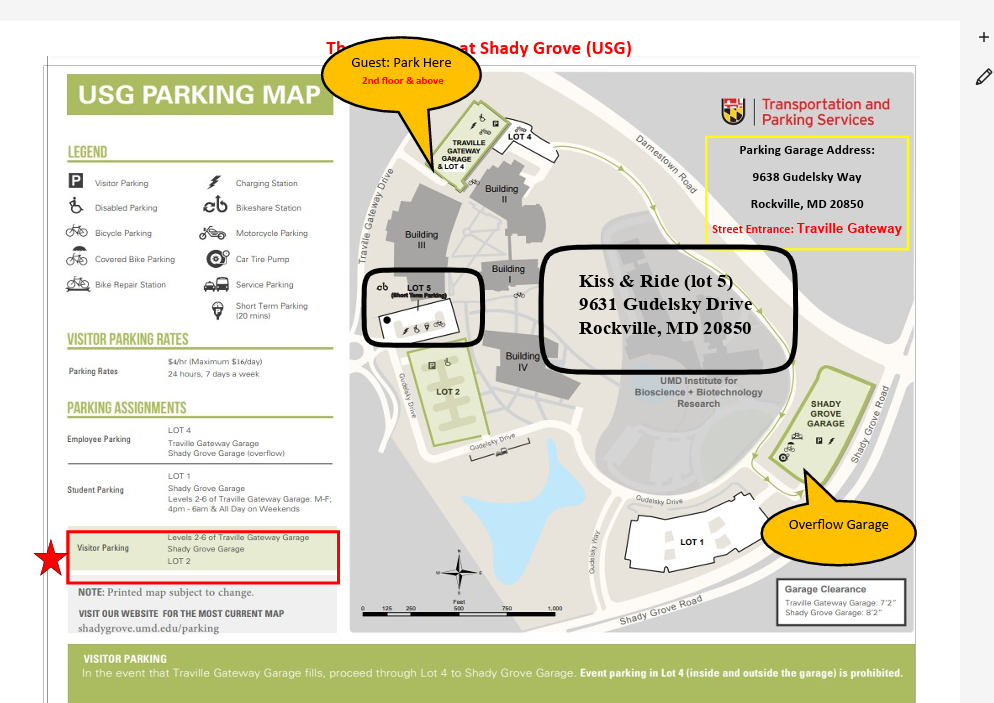
  • The Traville-Gateway Garage is the closest parking garage to the venue (parking map). Attendees may also park in Lot 2 and Shady Grove Garage but will need to allow more walking time to reach the event.
  • Visitor Parking: Levels 2-6 of Traville Gateway Garage. PLEASE NOTE: The ground floor of Traville Gateway Garage requires a USG employee permit at all times.
  • Guests are responsible for the cost of parking; parking will not be validated. Parking is $16 for all day.

Click for parking information from the USG website.

Please click on the following “all transportation options” links to find transportation from the airport via subway, bus, taxi, car, and town car.

  • Train tickets (Omio)
  • Washington, DC to Baltimore: Approximately 35 minutes
  • Penn Station Marc SB (Baltimore): Approximately 41 miles from campus

Empire Sedan & Limo Services (empiresedan12@gmail.com):  240-988-1796

Washington Flyer Taxi:  703-572-TAXI or 706-853-6094

Regency Taxi:  301-984-1900

Bob’s Limo Service (Email): 301-525-2525

B&B Executive Sedan (Email): 240-533-6262

East Coast Limousine (Email): 301-527-0413 or 240-793-8196

Uber: BaltimoreBWI AirportWashington, DCDulles (IAD) Airport

If using Uber, plese see the Uber Map for the designated spot for drop off and pick up for the workshop.  Do not request to be picked up/dropped off at the Traville-Gateway parking garage.

Address for Uber:
Universiites at Shady Grove
Lot 5
9631 Gudelsky Drive
Rockville, MD 20850


Guests should mention they are attending a conference at Universities of Shady Grove; most hotels offer discounts.

There are many hotels within a short driving distance to the USG campus including: