Reverse engineering, IVR and small-scale manufacturing of ONIVYDE™ (irinotecan liposome injection)

Project Summary


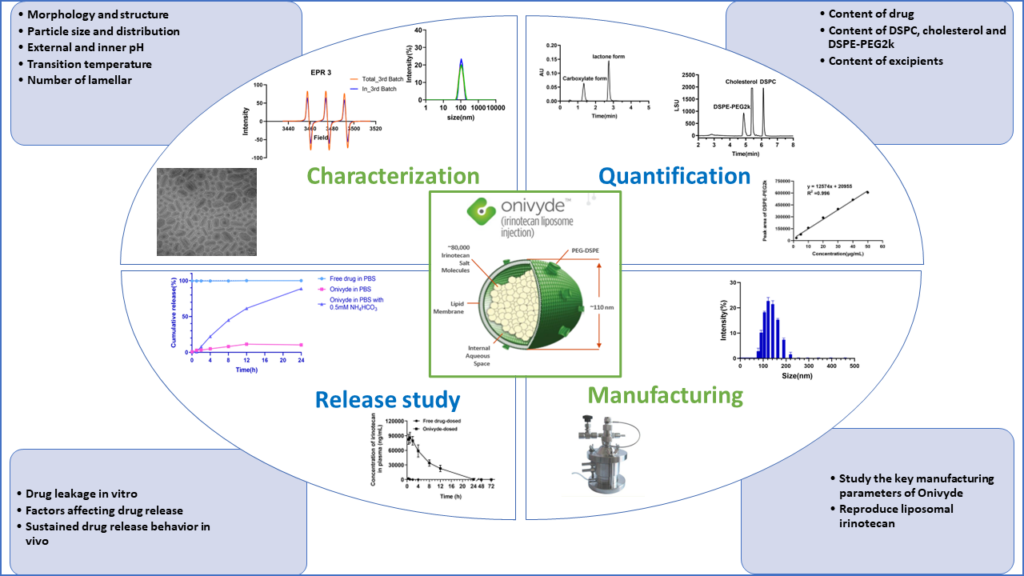
Reverse Engineering of ONIVYDE graphical abstact


Based on insights from interviews and surveys conducted by CRCG, we identified the need for research focused on “reverse engineering” of complex generic products and in vitro release (IVR) methodologies for liposomal products due to inherent difficulties in validating IVR methodologies and challenges in showing their discriminative abilities between batches of liposomes at various stages of the development cycle.

This project will focus on analytical characterization ONIVYDE™, an irinotecan liposome injection for intravenous use, establishing a USP-4 apparatus based IVR assay to examine the release of irinotecan from the liposomes and small-scale manufacturing of irinotecan liposome injection.

References

1. Juang V, Gan J, Xia Z, Wang Y, and Schwendeman A (2024).  Development and Optimization of an In Vitro Release Assay for Evaluation of Liposomal Irinotecan Formulation.  DOI: 10.1016/j.ijpharm.2024.124854.  Int J Pharm.  667(Pt A):124854. 

2. Gan J, Juang V, Wang K, Xia Z, Ackermann R, Yu M, Dorsey KH, Lin W, Wang X, Wang Y, Liang J, Zheng J, Xu X, Park JH, and Schwendeman A (2025).  Reverse Engineering of Onivyde® – Irinotecan Liposome Injection.  DOI: 10.1016/j.ijpharm.2024.125000.  Int J Pharm.  669:125000. 

3. Li J, Juang V, Lu Z, Wang Y, and Schwendeman A (2025).  In Vitro Method Development for Onivyde® Using Agilent NanoDis® System.  DOI: 10.1016/j.ijpharm.2025.125903.  Int J Pharm.  682:125903.